


Training Today to Respond Tomorrow
CVET Conducts Annual Full-Scale Exercise in Napa
When a disaster strikes, California Veterinary Emergency Team (CVET) responders must be ready to mobilize quickly, work together seamlessly, and provide veterinary support in challenging and rapidly evolving conditions.
That degree of readiness doesn't happen by chance. In addition to CVET's year-round trainings, educational webinars, and preparedness initiatives, annual full-scale exercises provide responders with the opportunity to put their training into practice before a real emergency occurs.

This year, 50 CVET responders from across California joined the UC Davis-based CVET Management Team in Napa for a two-day full-scale exercise designed to simulate real-world response conditions. Hosted in partnership with local organizations, the exercise utilized the Napa Valley Horsemen's Association as a large animal shelter site and the Napa County Animal Shelter as a small animal shelter location.
For this event, responders cooperatively practiced a variety of realistic scenarios involving both large and small domestic animals, working within the same standardized systems and protocols they would use during an actual deployment.
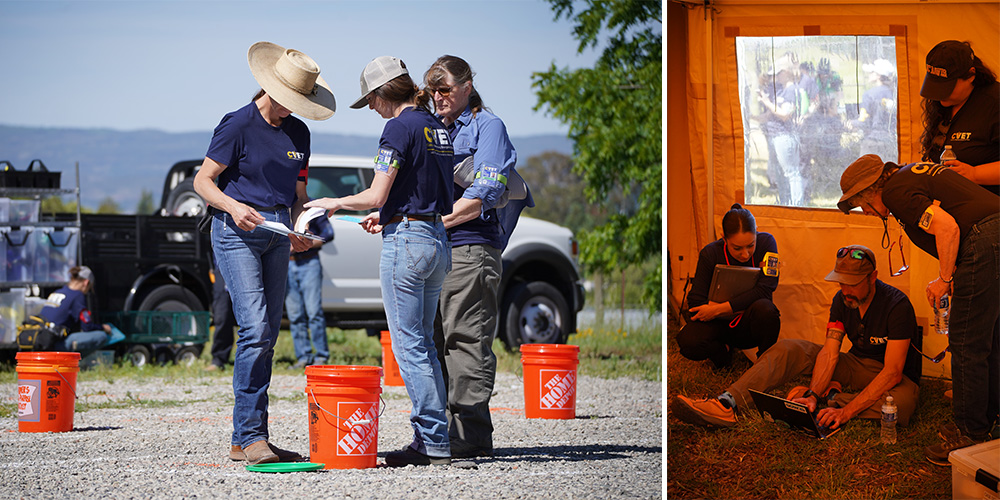
Throughout the exercise, responders worked through patient intake, shelter operations, animal care, team coordination, and incident management activities. The scenarios developed by CVET Staff challenged participants to apply their technical veterinary expertise while navigating the communication, logistics, and decision-making demands that accompany real responses.

Just as importantly, the exercise provided valuable opportunities to evaluate and refine CVET's operational procedures. Feedback gathered from responders and evaluators will help shape future trainings and exercises, and will help update and improve response protocols as CVET continues strengthening California's veterinary disaster response capabilities.
Building Skills Across Species
A special addition to this year's exercise came on the second day, when participants were invited to take part in an optional animal handling workshop hosted by Dr. Claudia Sonder, President of Napa CART and Vice President of the Cal CARTs Board of Directors. The hands-on training gave responders the opportunity to work with species they may not routinely encounter in their day-to-day professions.

Participants practiced handling goats, horses, and poultry, while also rotating through bandaging stations that highlighted the differences between treating small and large animal patients.

Over the course of two days, responders tested their skills, strengthened partnerships, and helped identify opportunities for improvement, all in service of building an even stronger veterinary disaster response capability for California.